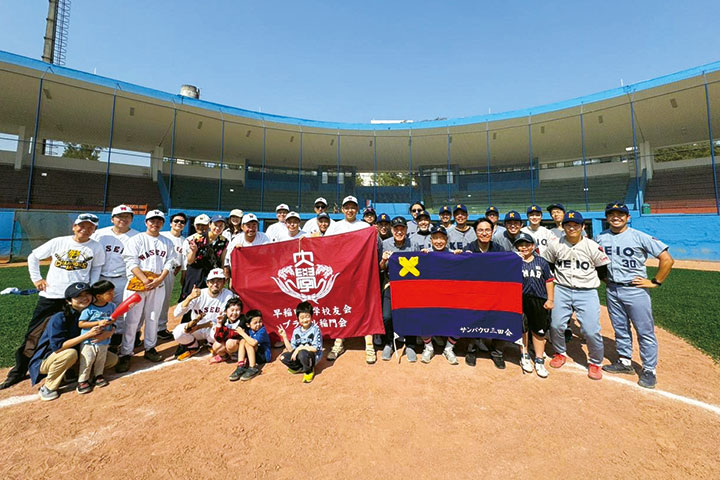
Brazil is the largest country in South America and home to diverse ethnic groups. Japanese predecessors who immigrated to Brazil, among whom were also graduates of Waseda, have established the trust and culture of Japanese people. The Brazil Tomonkai is the “spiritual home” built by such seniors. We are currently a large group of about 80 members, including those who came as expatriates, upon marriage, or to start their business. We have also interacted with current students on occasions such as the three games held by the Waseda University Baseball Club and Keio University Baseball Club in commemoration of Japan–Brazil relations and the Glee Club performances in Brazil. As a variety of members from seniors to current students meet, spend time together, and share “The infinite Eternal Aim, Careful, too, of present need,” we feel the spirit of Waseda even in Brazil.
“Oh, the land of dreams”—Since I came to Brazil, the farthest country from Japan, on a two-year contract in January 1991 at the age of 23, I have gone through many twists and turns in my work and private life, and long 35 years have passed instead of “a lapse of 3 years.” Even in Brazil, where “I came alone, guided by floating clouds as a twist of fate,” “Waseda is my garden of learning” (from the speech in Theater of Life). Shinichiro Ishioka(Graduated in 1990, School of Education)
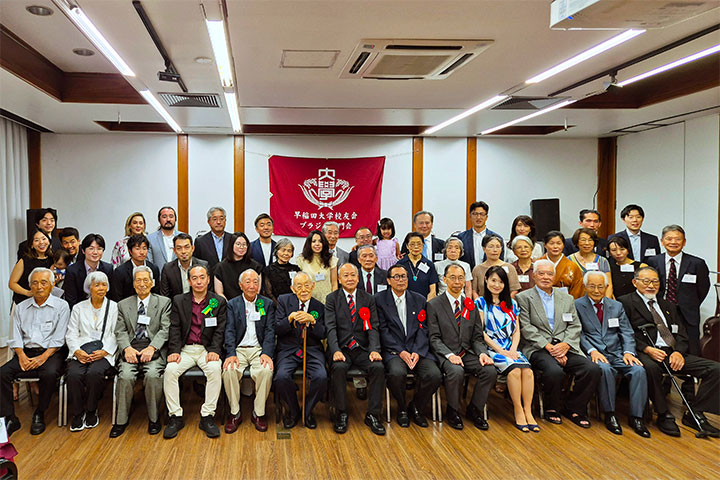
Brazil Tomonkai’s 70th anniversary ceremony and celebration held on March 8, 2025
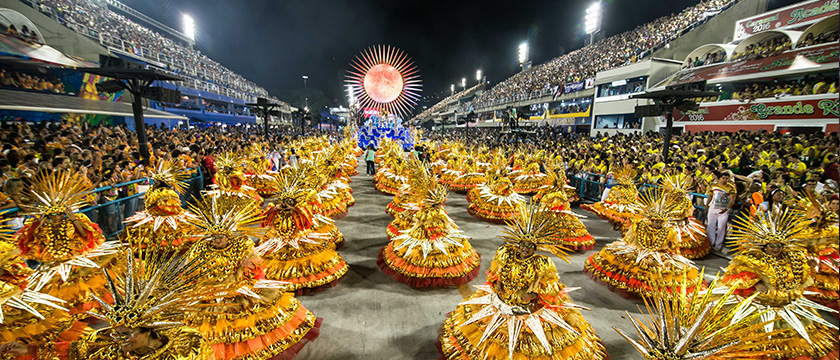
The attractive points of Brazil
Brazil occupies almost half of the South American continent and is approximately 22.5 times larger than Japan. The vast land is full of charms interwoven by diverse geographical features and rich cultures.
The biggest attraction is its magnificent nature, including the Amazon rainforest, also known as the lungs of the planet. Iguazu Falls, one of the world’s largest waterfall systems, is also located on the border with Argentina, and Lençóis Maranhenses National Park in the northeast offers dream-like scenery of numerous puddles appearing on the sand dune during the rainy season.
Another charm is its melting-pot society and warm-hearted people. Thanks to the history of coexistence of Indigenous, White, and Black people and reception of immigrants from around the world, a generous and friendly atmosphere is rooted in the society. Cheerful and festive people who enjoy gathering with their family and friends for a barbecue, etc., on the weekend are also characteristic.
Brazil is also home to the largest number of Japanese descendants in the world and has deep ties with Japan. Japanese culture has taken root, and even vegetables such as napa cabbage and burdock can be found at the morning market in São Paulo. Manami Takano(Graduated in 2011, School of International Liberal Studies)
Message from the Chairperson
I am Masayuki Muranobu; I was appointed as the sixth Chairperson at Brazil Tomonkai’s 70th anniversary ceremony and celebration in March this year. Our members mainly comprise immigrants, long-term residents, expatriates, and former foreign students living in Greater São Paulo. If you live in Brazil, please join our Tomonkai. There are no annual fees. We hold a general assembly and gathering in March every year.
And to everyone in Japan and around the world, São Paulo has a warm climate, and you can play golf in short sleeves and shorts for 10 months a year. Temaki (temakizushi) and yakissoba (yakisoba) have already become Brazil’s national dishes. Thanks to the 120-year history of Japanese immigrants, there is absolute trust in Japanese people. Japanese people here often say that there is nowhere else more livable than here, although there is room for improvement regarding security. It is a great place, so please come visit Brazil. (I am writing this on the day Japan welcomed President Lula of Brazil to Tokyo as an official state guest for the first time in six years.) Masayuki Muranobu(Graduated in 1978, School of Literature Ⅱ)
Messages from the Members
Our Tomonkai allows us to casually interact with permanent residents, expatriates, and short-term residents of Brazil. We have a blast every year at the baseball, tennis, and golf games with Mita-kai! Many alumni came to cheer the Waseda–Keio baseball game at the baseball stadium in São Paulo in August last year. After the games, we usually have lunch together, including with the family members of participants from both universities, to deepen their friendships. Kotaro Kawana(Graduated in 2008, School of Commerce, Graduated in 2010, Graduate School of Sport Sciences)
At our Tomonkai, members of different ages and attributes, including seniors who graduated from Waseda even before I was born and juniors who are close in age to my children, enjoy friendly and professional interactions. We also actively interact with local Mita-kai throughout the year, holding golf, baseball, and tennis games. Such encounters are beneficial, both personally and professionally. If you come to Brazil, whether for a long or short time, do not hesitate to join us. Yoshitsugu Hamano(Graduated in 1995, School of Commerce)
On March 8, 2025, we held Brazil Tomonkai’s 70th anniversary ceremony and celebration at Nikkey Palace Hotel in São Paulo. It gathered from old seniors who came to Brazil by ship after the war to alumni in their 30s, including energetic expatriates and third- and fourth-generation Japanese who studied at Waseda as foreign students and now work in Brazil. It was a wonderful celebration that enlivened us while feeling the Waseda spirit that had been passed down through generations. Let me share a short poem about this occasion.
“Beyond borders the fields of Waseda extend / With the infinite Eternal Aim always in mind” Yumiko Hayashi(Graduated in 1991, School of Law)
In Japan, we can meet friends from the university any time and even get to know other alumni at work or leisure, but this is not the case abroad. The Tomonkai, which allows us to meet people with the same background in Brazil on the opposite side of the Earth from Japan, is therefore precious and provides emotional support. If you live in Brazil and want to share something in common, do not hesitate to contact us! Yasuhiro Kondo(Graduated in 2001, School of Law)
The organization of Waseda University graduates is called the Tomonkai. The Tomonkai is active all over Japan and around the world, throughout different regions, age groups, and industries.
Tomonkai Alumni Network
The organization of Waseda University graduates is called the Tomonkai. The Tomonkai is active all over Japan and around the world, throughout different regions, age groups, and industries.
Supporting Waseda
Your alumni association dues are used to fund scholarships, the 100-yen breakfast project, lectures funded by the Alumni Association, and other activities to support the university and current students.
Supporting Waseda
Your alumni association dues are used to fund scholarships, the 100-yen breakfast project, lectures funded by the Alumni Association, and other activities to support the university and current students.
Benefits
Dues-paying members receive the alumni association magazine in the mail and are also eligible for a variety of services, including welfare services and use of facilities.
Benefits
Dues-paying members receive the alumni association magazine in the mail and are also eligible for a variety of services, including welfare services and use of facilities.
Events
The WUAA plans and holds a variety of events to deepen connections between its members and bring back memories of their school days.
Events
The WUAA plans and holds a variety of events to deepen connections between its members and bring back memories of their school days.
Issuing Certificates
Explains how certificates are issued for graduates.
Issuing Certificates
Explains how certificates are issued for graduates.
Register/Change Personal Information
Explains registration of/changes to personal information and how to create a WasedaMail address.
Register/Change Personal Information
Explains registration of/changes to personal information and how to create a WasedaMail address.